

Irrational Numbers Greater Than 10
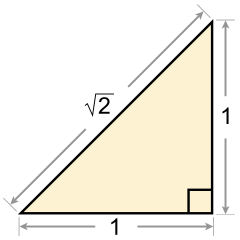
The number √2 is irrational.
In mathematics, the irrational numbers (from in- prefix assimilated to ir- (negative prefix, privative) + rational) are all the real numbers that are not rational numbers. That is, irrational numbers cannot be expressed as the ratio of two integers. When the ratio of lengths of 2 line segments is an irrational number, the line segments are also described as being incommensurable, significant that they share no "measure" in common, that is, there is no length ("the measure out"), no matter how short, that could exist used to limited the lengths of both of the two given segments as integer multiples of itself.
Among irrational numbers are the ratio π of a circle's circumference to its diameter, Euler's number east, the golden ratio φ, and the foursquare root of ii.[ane] [2] [3] In fact, all foursquare roots of natural numbers, other than of perfect squares, are irrational.[4]
Similar all real numbers, irrational numbers tin be expressed in positional notation, notably as a decimal number. In the instance of irrational numbers, the decimal expansion does not finish, nor stop with a repeating sequence. For case, the decimal representation of π starts with three.14159, merely no finite number of digits can represent π exactly, nor does it repeat. Conversely, a decimal expansion that terminates or repeats must exist a rational number. These are provable properties of rational numbers and positional number systems, and are non used as definitions in mathematics.
Irrational numbers tin as well be expressed as non-terminating continued fractions and many other ways.
Every bit a consequence of Cantor's proof that the real numbers are uncountable and the rationals countable, it follows that most all existent numbers are irrational.[v]
History [edit]
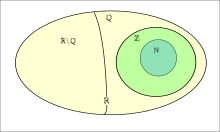
Ready of existent numbers (R), which include the rationals (Q), which include the integers (Z), which include the natural numbers (N). The existent numbers besides include the irrationals (R\Q).
Ancient Greece [edit]
The starting time proof of the existence of irrational numbers is unremarkably attributed to a Pythagorean (perhaps Hippasus of Metapontum),[half dozen] who probably discovered them while identifying sides of the pentagram.[vii] The then-electric current Pythagorean method would have claimed that at that place must be some sufficiently small, indivisible unit that could fit evenly into 1 of these lengths as well as the other. Hippasus, in the 5th century BC, nonetheless, was able to deduce that at that place was in fact no mutual unit of measure, and that the assertion of such an existence was in fact a contradiction. He did this by demonstrating that if the hypotenuse of an isosceles right triangle was indeed commensurable with a leg, then one of those lengths measured in that unit of measurement of measure must be both odd and even, which is incommunicable. His reasoning is as follows:
- Offset with an isosceles correct triangle with side lengths of integers a, b, and c. The ratio of the hypotenuse to a leg is represented by c:b.
- Assume a, b, and c are in the smallest possible terms (i.e. they have no common factors).
- By the Pythagorean theorem: c 2 = a 2+b 2 = b 2+b 2 = 2b ii. (Since the triangle is isosceles, a = b).
- Since c 2 = iib 2, c 2 is divisible by 2, and therefore even.
- Since c 2 is even, c must be fifty-fifty.
- Since c is even, dividing c by 2 yields an integer. Let y be this integer (c = 2y).
- Squaring both sides of c = 2y yields c 2 = (2y)2, or c ii = 4y 2.
- Substituting 4y 2 for c 2 in the showtime equation (c 2 = twob 2) gives us 4y 2= 2b ii.
- Dividing by 2 yields iiy 2 = b 2.
- Since y is an integer, and iiy 2 = b 2, b 2 is divisible by 2, and therefore even.
- Since b 2 is fifty-fifty, b must be even.
- We have just shown that both b and c must be even. Hence they have a mutual factor of two. However this contradicts the assumption that they have no mutual factors. This contradiction proves that c and b cannot both be integers, and thus the existence of a number that cannot be expressed every bit a ratio of ii integers.[8]
Greek mathematicians termed this ratio of incommensurable magnitudes alogos, or inexpressible. Hippasus, nonetheless, was not lauded for his efforts: according to one legend, he made his discovery while out at body of water, and was subsequently thrown overboard by his beau Pythagoreans "... for having produced an element in the universe which denied the... doctrine that all phenomena in the universe can be reduced to whole numbers and their ratios."[9] Another fable states that Hippasus was merely exiled for this revelation. Whatever the consequence to Hippasus himself, his discovery posed a very serious problem to Pythagorean mathematics, since information technology shattered the supposition that number and geometry were inseparable–a foundation of their theory.
The discovery of incommensurable ratios was indicative of some other trouble facing the Greeks: the relation of the discrete to the continuous. This was brought into calorie-free by Zeno of Elea, who questioned the conception that quantities are discrete and composed of a finite number of units of a given size. Past Greek conceptions dictated that they necessarily must be, for "whole numbers represent discrete objects, and a commensurable ratio represents a relation betwixt two collections of discrete objects",[10] but Zeno found that in fact "[quantities] in general are not detached collections of units; this is why ratios of incommensurable [quantities] appear... .[Q]uantities are, in other words, continuous".[10] What this means is that, contrary to the popular conception of the time, at that place cannot be an indivisible, smallest unit of measure for any quantity. That in fact, these divisions of quantity must necessarily be infinite. For case, consider a line segment: this segment can be split in half, that one-half separate in half, the half of the half in half, and so on. This process can continue infinitely, for at that place is always some other half to be dissever. The more than times the segment is halved, the closer the unit of measure comes to zero, but it never reaches exactly zero. This is only what Zeno sought to show. He sought to prove this past formulating iv paradoxes, which demonstrated the contradictions inherent in the mathematical thought of the time. While Zeno'due south paradoxes accurately demonstrated the deficiencies of current mathematical conceptions, they were not regarded every bit proof of the alternative. In the minds of the Greeks, disproving the validity of i view did non necessarily bear witness the validity of another, and therefore further investigation had to occur.
The next step was taken by Eudoxus of Cnidus, who formalized a new theory of proportion that took into account commensurable too as incommensurable quantities. Fundamental to his thought was the distinction betwixt magnitude and number. A magnitude "...was not a number but stood for entities such as line segments, angles, areas, volumes, and fourth dimension which could vary, as nosotros would say, continuously. Magnitudes were opposed to numbers, which jumped from one value to another, as from 4 to 5".[11] Numbers are composed of some smallest, indivisible unit, whereas magnitudes are infinitely reducible. Because no quantitative values were assigned to magnitudes, Eudoxus was so able to business relationship for both commensurable and incommensurable ratios by defining a ratio in terms of its magnitude, and proportion as an equality between two ratios. By taking quantitative values (numbers) out of the equation, he avoided the trap of having to express an irrational number as a number. "Eudoxus' theory enabled the Greek mathematicians to make tremendous progress in geometry by supplying the necessary logical foundation for incommensurable ratios".[12] This incommensurability is dealt with in Euclid's Elements, Volume X, Proffer 9. Information technology was not until Eudoxus developed a theory of proportion that took into account irrational as well every bit rational ratios that a strong mathematical foundation of irrational numbers was created.[13]
As a outcome of the stardom between number and magnitude, geometry became the simply method that could take into account incommensurable ratios. Because previous numerical foundations were still incompatible with the concept of incommensurability, Greek focus shifted away from those numerical conceptions such equally algebra and focused almost exclusively on geometry. In fact, in many cases algebraic conceptions were reformulated into geometric terms. This may business relationship for why we still conceive of ten 2 and x iii as x squared and x cubed instead of 10 to the second power and x to the third power. Also crucial to Zeno's work with incommensurable magnitudes was the fundamental focus on deductive reasoning that resulted from the foundational shattering of earlier Greek mathematics. The realization that some bones conception within the existing theory was at odds with reality necessitated a complete and thorough investigation of the axioms and assumptions that underlie that theory. Out of this necessity, Eudoxus developed his method of burnout, a kind of reductio advertizing absurdum that "...established the deductive arrangement on the basis of explicit axioms..." likewise as "...reinforced the earlier decision to rely on deductive reasoning for proof".[14] This method of exhaustion is the first pace in the creation of calculus.
Theodorus of Cyrene proved the irrationality of the surds of whole numbers up to 17, but stopped there probably because the algebra he used could not exist applied to the square root of 17.[fifteen]
India [edit]
Geometrical and mathematical bug involving irrational numbers such as square roots were addressed very early on during the Vedic period in India. There are references to such calculations in the Samhitas, Brahmanas, and the Shulba Sutras (800 BC or earlier). (See Bag, Indian Journal of History of Science, 25(1-4), 1990).
It is suggested that the concept of irrationality was implicitly accepted by Indian mathematicians since the seventh century BC, when Manava (c. 750 – 690 BC) believed that the square roots of numbers such as 2 and 61 could not be exactly determined.[sixteen] Historian Carl Benjamin Boyer, however, writes that "such claims are not well substantiated and unlikely to be true".[17]
It is besides suggested that Aryabhata (fifth century Ad), in calculating a value of pi to 5 pregnant figures, used the discussion āsanna (approaching), to mean that not only is this an approximation but that the value is incommensurable (or irrational).
Afterward, in their treatises, Indian mathematicians wrote on the arithmetics of surds including add-on, subtraction, multiplication, rationalization, as well equally separation and extraction of foursquare roots.[eighteen]
Mathematicians like Brahmagupta (in 628 AD) and Bhāskara I (in 629 Advertising) made contributions in this surface area every bit did other mathematicians who followed. In the 12th century Bhāskara II evaluated some of these formulas and critiqued them, identifying their limitations.
During the 14th to 16th centuries, Madhava of Sangamagrama and the Kerala school of astronomy and mathematics discovered the infinite series for several irrational numbers such every bit π and certain irrational values of trigonometric functions. Jyeṣṭhadeva provided proofs for these infinite serial in the Yuktibhāṣā.[19]
Middle Ages [edit]
In the Heart ages, the development of algebra by Muslim mathematicians immune irrational numbers to exist treated equally algebraic objects.[xx] Centre Eastern mathematicians also merged the concepts of "number" and "magnitude" into a more general thought of real numbers, criticized Euclid'due south idea of ratios, developed the theory of composite ratios, and extended the concept of number to ratios of continuous magnitude.[21] In his commentary on Book 10 of the Elements, the Persian mathematician Al-Mahani (d. 874/884) examined and classified quadratic irrationals and cubic irrationals. He provided definitions for rational and irrational magnitudes, which he treated as irrational numbers. He dealt with them freely but explains them in geometric terms as follows:[21]
"It will be a rational (magnitude) when we, for instance, say ten, 12, 3%, 6%, etc., because its value is pronounced and expressed quantitatively. What is not rational is irrational and it is impossible to pronounce and represent its value quantitatively. For example: the roots of numbers such as x, xv, 20 which are not squares, the sides of numbers which are non cubes etc."
In contrast to Euclid'south concept of magnitudes as lines, Al-Mahani considered integers and fractions equally rational magnitudes, and square roots and cube roots equally irrational magnitudes. He also introduced an arithmetical approach to the concept of irrationality, equally he attributes the following to irrational magnitudes:[21]
"their sums or differences, or results of their addition to a rational magnitude, or results of subtracting a magnitude of this kind from an irrational one, or of a rational magnitude from it."
The Egyptian mathematician Abū Kāmil Shujā ibn Aslam (c. 850 – 930) was the first to take irrational numbers as solutions to quadratic equations or as coefficients in an equation, frequently in the form of square roots, cube roots and quaternary roots.[22] In the tenth century, the Iraqi mathematician Al-Hashimi provided general proofs (rather than geometric demonstrations) for irrational numbers, as he considered multiplication, division, and other arithmetical functions.[21] Iranian mathematician, Abū Ja'far al-Khāzin (900–971) provides a definition of rational and irrational magnitudes, stating that if a definite quantity is:[21]
"contained in a certain given magnitude once or many times, so this (given) magnitude corresponds to a rational number. . . . Each time when this (latter) magnitude comprises a half, or a third, or a quarter of the given magnitude (of the unit), or, compared with (the unit), comprises three, five, or three fifths, it is a rational magnitude. And, in full general, each magnitude that corresponds to this magnitude (i.e. to the unit of measurement), as one number to another, is rational. If, however, a magnitude cannot be represented every bit a multiple, a office (ane/due north), or parts (m/n) of a given magnitude, information technology is irrational, i.e. information technology cannot be expressed other than by means of roots."
Many of these concepts were eventually accustomed by European mathematicians sometime after the Latin translations of the 12th century. Al-Hassār, a Moroccan mathematician from Fez specializing in Islamic inheritance jurisprudence during the 12th century, first mentions the utilise of a fractional bar, where numerators and denominators are separated by a horizontal bar. In his discussion he writes, "..., for example, if you are told to write iii-fifths and a tertiary of a fifth, write thus, ."[23] This same partial notation appears soon after in the work of Leonardo Fibonacci in the 13th century.[24]

Modern menstruum [edit]
The 17th century saw imaginary numbers go a powerful tool in the hands of Abraham de Moivre, and especially of Leonhard Euler. The completion of the theory of circuitous numbers in the 19th century entailed the differentiation of irrationals into algebraic and transcendental numbers, the proof of the existence of transcendental numbers, and the resurgence of the scientific report of the theory of irrationals, largely ignored since Euclid. The year 1872 saw the publication of the theories of Karl Weierstrass (past his pupil Ernst Kossak), Eduard Heine (Crelle'south Journal, 74), Georg Cantor (Annalen, five), and Richard Dedekind. Méray had taken in 1869 the same betoken of departure as Heine, but the theory is mostly referred to the twelvemonth 1872. Weierstrass'southward method has been completely set forth by Salvatore Pincherle in 1880,[25] and Dedekind's has received boosted prominence through the author's subsequently work (1888) and the endorsement past Paul Tannery (1894). Weierstrass, Cantor, and Heine base their theories on space series, while Dedekind founds his on the idea of a cutting (Schnitt) in the system of all rational numbers, separating them into ii groups having certain characteristic backdrop. The discipline has received afterward contributions at the hands of Weierstrass, Leopold Kronecker (Crelle, 101), and Charles Méray.
Continued fractions, closely related to irrational numbers (and due to Cataldi, 1613), received attention at the hands of Euler, and at the opening of the 19th century were brought into prominence through the writings of Joseph-Louis Lagrange. Dirichlet also added to the full general theory, as take numerous contributors to the applications of the subject.
Johann Heinrich Lambert proved (1761) that π cannot be rational, and that east n is irrational if n is rational (unless n = 0).[26] While Lambert'south proof is ofttimes called incomplete, modern assessments back up it as satisfactory, and in fact for its time it is unusually rigorous. Adrien-Marie Legendre (1794), subsequently introducing the Bessel–Clifford part, provided a proof to show that πii is irrational, whence information technology follows immediately that π is irrational also. The being of transcendental numbers was first established past Liouville (1844, 1851). Afterwards, Georg Cantor (1873) proved their existence by a different method, which showed that every interval in the reals contains transcendental numbers. Charles Hermite (1873) first proved e transcendental, and Ferdinand von Lindemann (1882), starting from Hermite'due south conclusions, showed the same for π. Lindemann's proof was much simplified by Weierstrass (1885), still further by David Hilbert (1893), and was finally made elementary by Adolf Hurwitz[ citation needed ] and Paul Gordan.[27]
Examples [edit]
Square roots [edit]
The square root of 2 was likely the first number proved irrational.[28] The golden ratio is some other famous quadratic irrational number. The square roots of all natural numbers that are non perfect squares are irrational and a proof may exist establish in quadratic irrationals.
Full general roots [edit]
The proof above[ clarification needed ] for the square root of ii can be generalized using the fundamental theorem of arithmetics. This asserts that every integer has a unique factorization into primes. Using information technology we can show that if a rational number is not an integer then no integral power of it tin can exist an integer, as in everyman terms there must be a prime in the denominator that does non divide into the numerator whatever power each is raised to. Therefore, if an integer is not an exact chiliadthursday ability of some other integer, then that beginning integer's kth root is irrational.
Logarithms [edit]
Perchance the numbers nearly easy to show irrational are certain logarithms. Hither is a proof by contradiction that logtwo 3 is irrational (log2 3 ≈ ane.58 > 0).
Assume log2 three is rational. For some positive integers m and north, we take

It follows that

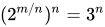

The number 2 raised to any positive integer power must be even (because it is divisible past 2) and the number iii raised to any positive integer power must exist odd (since none of its prime number factors will be two). Clearly, an integer cannot be both odd and even at the aforementioned fourth dimension: we have a contradiction. The only assumption we fabricated was that logtwo iii is rational (and and then expressible as a quotient of integers k/northward with n ≠ 0). The contradiction means that this assumption must exist false, i.e. log2 three is irrational, and tin can never be expressed as a quotient of integers m/n with n ≠ 0.
Cases such every bit log10 ii can exist treated similarly.
Types [edit]
- number theoretic distinction : transcendental/algebraic
- normal/ abnormal (not-normal)
Transcendental/algebraic [edit]
Almost all irrational numbers are transcendental and all existent transcendental numbers are irrational (there are as well complex transcendental numbers): the commodity on transcendental numbers lists several examples. And then e r and πr are irrational for all nonzero rationalr, and, e.k., e π is irrational, as well.
Irrational numbers tin likewise be found within the countable gear up of real algebraic numbers (essentially divers as the existent roots of polynomials with integer coefficients), i.e., as real solutions of polynomial equations

where the coefficients are integers and . Any rational root of this polynomial equation must be of the form r /s, where r is a divisor of a 0 and s is a divisor of a n . If a real root of a polynomial is non among these finitely many possibilities, it must be an irrational algebraic number. An exemplary proof for the existence of such algebraic irrationals is by showing that x 0 = (2one/2 + one)1/3 is an irrational root of a polynomial with integer coefficients: it satisfies (10 three − 1)2 = 2 and hence x 6 − 2x iii − 1 = 0, and this latter polynomial has no rational roots (the but candidates to cheque are ±i, andx 0, being greater than 1, is neither of these), soten 0 is an irrational algebraic number.


Because the algebraic numbers class a subfield of the existent numbers, many irrational real numbers can be synthetic past combining transcendental and algebraic numbers. For example, threeπ + 2, π +√ii and e √3 are irrational (and even transcendental).
Decimal expansions [edit]
The decimal expansion of an irrational number never repeats or terminates (the latter beingness equivalent to repeating zeroes), unlike any rational number. The same is true for binary, octal or hexadecimal expansions, and in full general for expansions in every positional notation with natural bases.
To show this, suppose nosotros dissever integers n past m (where m is nonzero). When long sectionalisation is applied to the division of due north by m, at that place tin never exist a rest greater than or equal to thousand. If 0 appears as a remainder, the decimal expansion terminates. If 0 never occurs, so the algorithm tin run at most m − 1 steps without using any remainder more than one time. After that, a residual must recur, and then the decimal expansion repeats.
Conversely, suppose nosotros are faced with a repeating decimal, nosotros tin prove that it is a fraction of two integers. For example, consider:

Hither the repetend is 162 and the length of the repetend is 3. First, nosotros multiply by an appropriate power of ten to move the decimal indicate to the right so that information technology is just in front of a repetend. In this example we would multiply past 10 to obtain:

Now we multiply this equation past 10 r where r is the length of the repetend. This has the issue of moving the decimal signal to be in front end of the "next" repetend. In our example, multiply by 10three:

The result of the two multiplications gives two unlike expressions with exactly the same "decimal portion", that is, the tail cease of x,000A matches the tail end of 10A exactly. Here, both 10,000A and tenA accept .162162 162 ... afterward the decimal point.
Therefore, when nosotros subtract the 10A equation from the 10,000A equation, the tail terminate of xA cancels out the tail terminate of 10,000A leaving united states with:

Then
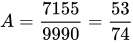
is a ratio of integers and therefore a rational number.
Irrational powers [edit]
Dov Jarden gave a simple non-constructive proof that there exist two irrational numbers a and b, such that a b is rational:[29]
Consider √two √2 ; if this is rational, and then have a = b = √ii . Otherwise, take a to be the irrational number √2 √2 and b = √two . Then a b = (√two √ii ) √2 = √2 √2 ·√2 = √2 ii = ii, which is rational.
Although the above argument does non decide betwixt the two cases, the Gelfond–Schneider theorem shows that √2 √2 is transcendental, hence irrational. This theorem states that if a and b are both algebraic numbers, and a is not equal to 0 or ane, and b is not a rational number, and so whatever value of a b is a transcendental number (there can exist more than one value if complex number exponentiation is used).
An example that provides a simple constructive proof is[30]
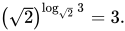
The base of operations of the left side is irrational and the right side is rational, so one must evidence that the exponent on the left side, , is irrational. This is and so because, past the formula relating logarithms with different bases,


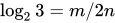
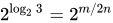
which we can assume, for the sake of establishing a contradiction, equals a ratio g/due north of positive integers. And so hence hence hence , which is a contradictory pair of prime number factorizations and hence violates the fundamental theorem of arithmetic (unique prime number factorization).


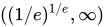
A stronger event is the post-obit:[31] Every rational number in the interval can exist written either as a a for some irrational number a or as n n for some natural number n. Similarly,[31] every positive rational number can exist written either equally for some irrational number a or as for some natural number northward.


Open up questions [edit]
It is not known if (or ) is irrational. In fact, there is no pair of not-zippo integers for which information technology is known whether is irrational. Moreover, it is non known if the set is algebraically independent over .


It is not known if Catalan'due south constant, or the Euler–Mascheroni constant are irrational.[32] [33] [34] Information technology is not known if either of the tetrations or is rational for some integer [ commendation needed ]



In constructive mathematics [edit]
In effective mathematics, excluded middle is not valid, then it is not true that every real number is rational or irrational. Thus, the notion of an irrational number bifurcates into multiple distinct notions. Ane could accept the traditional definition of an irrational number as a real number that is not rational.[35] However, there is a 2nd definition of an irrational number used in constructive mathematics, that a real number is an irrational number if it is apart from every rational number, or equivalently, if the distance between and every rational number is positive. This definition is stronger than the traditional definition of an irrational number. This second definition is used in Errett Bishop'southward proof that the square root of ii is irrational.[36]


Set of all irrationals [edit]
Since the reals class an uncountable set, of which the rationals are a countable subset, the complementary set of irrationals is uncountable.
Under the usual (Euclidean) distance function , the existent numbers are a metric infinite and hence also a topological infinite. Restricting the Euclidean altitude function gives the irrationals the construction of a metric space. Since the subspace of irrationals is not closed, the induced metric is not complete. Existence a Thousand-delta fix—i.east., a countable intersection of open up subsets—in a consummate metric space, the space of irrationals is completely metrizable: that is, in that location is a metric on the irrationals inducing the aforementioned topology as the restriction of the Euclidean metric, but with respect to which the irrationals are consummate. One can come across this without knowing the same fact about G-delta sets: the continued fraction expansion of an irrational number defines a homeomorphism from the space of irrationals to the infinite of all sequences of positive integers, which is easily seen to be completely metrizable.

Furthermore, the gear up of all irrationals is a disconnected metrizable space. In fact, the irrationals equipped with the subspace topology have a basis of clopen sets then the space is zero-dimensional.
See also [edit]
- Brjuno number
- Computable number
- Diophantine approximation
- Proof that eastward is irrational
- Proof that π is irrational
- Square root of iii
- Foursquare root of 5
- Trigonometric number
| Circuitous |
|


References [edit]
- ^ The 15 Virtually Famous Transcendental Numbers. by Clifford A. Pickover. URL retrieved 24 October 2007.
- ^ "Irrational Numbers". mathsisfun.com . Retrieved 3 July 2022.
- ^ Weisstein, Eric W. "Irrational Number". MathWorld. URL retrieved 26 October 2007.
- ^ Jackson, Terence (2011-07-01). "95.42 Irrational square roots of natural numbers — a geometrical arroyo". The Mathematical Gazette. 95 (533): 327–330. doi:10.1017/S0025557200003193. ISSN 0025-5572. S2CID 123995083.
- ^ Cantor, Georg (1955) [1915]. Philip Jourdain (ed.). Contributions to the Founding of the Theory of Transfinite Numbers. New York: Dover. ISBN978-0-486-60045-1.
- ^ Kurt Von Fritz (1945). "The Discovery of Incommensurability by Hippasus of Metapontum". The Annals of Mathematics.
- ^ James R. Choike (1980). "The Pentagram and the Discovery of an Irrational Number". The Two-Yr College Mathematics Journal. .
- ^ Kline, K. (1990). Mathematical Thought from Ancient to Modern Times, Vol. 1. New York: Oxford University Press (original work published 1972), p. 33.
- ^ Kline 1990, p. 32.
- ^ a b Kline 1990, p. 34.
- ^ Kline 1990, p. 48.
- ^ Kline 1990, p. 49.
- ^ Charles H. Edwards (1982). The historical development of the calculus. Springer.
- ^ Kline 1990, p. 50.
- ^ Robert 50. McCabe (1976). "Theodorus' Irrationality Proofs". Mathematics Magazine. .
- ^ T. K. Puttaswamy, "The Accomplishments of Aboriginal Indian Mathematicians", pp. 411–ii, in Selin, Helaine; D'Ambrosio, Ubiratan, eds. (2000). Mathematics Across Cultures: The History of Non-western Mathematics. Springer. ISBNone-4020-0260-ii. .
- ^ Boyer (1991). "Cathay and India". A History of Mathematics (2nd ed.). p. 208. ISBN0471093742. OCLC 414892.
It has been claimed also that the commencement recognition of incommensurables appears in India during the Sulbasutra period, just such claims are non well substantiated. The case for early Hindu awareness of incommensurable magnitudes is rendered most unlikely by the lack of evidence that Indian mathematicians of that menses had come up to grips with fundamental concepts.
- ^ Datta, Bibhutibhusan; Singh, Awadhesh Narayan (1993). "Surds in Hindu mathematics" (PDF). Indian Journal of History of Scientific discipline. 28 (3): 253–264. Archived from the original (PDF) on 2018-10-03. Retrieved 18 September 2018.
- ^ Katz, V. J. (1995), "Ideas of Calculus in Islam and India", Mathematics Magazine (Mathematical Association of America) 68 (3): 163–74.
- ^ O'Connor, John J.; Robertson, Edmund F. (1999). "Arabic mathematics: forgotten luminescence?". MacTutor History of Mathematics archive. Academy of St Andrews. .
- ^ a b c d e Matvievskaya, Galina (1987). "The theory of quadratic irrationals in medieval Oriental mathematics". Register of the New York Academy of Sciences. 500 (1): 253–277. Bibcode:1987NYASA.500..253M. doi:10.1111/j.1749-6632.1987.tb37206.x. S2CID 121416910. See in item pp. 254 & 259–260.
- ^ Jacques Sesiano, "Islamic mathematics", p. 148, in Selin, Helaine; D'Ambrosio, Ubiratan (2000). Mathematics Across Cultures: The History of Non-western Mathematics. Springer. ISBN1-4020-0260-2. .
- ^ Cajori, Florian (1928). A History of Mathematical Notations (Vol.1). La Salle, Illinois: The Open Court Publishing Company. pg. 269.
- ^ (Cajori 1928, pg.89)
- ^ Salvatore Pincherle (1880). "Saggio di una introduzione alla teoria delle funzioni analitiche secondo i principii del prof. C. Weierstrass". Giornale di Matematiche: 178–254, 317–320.
- ^ Lambert, J. H. (1761). "Mémoire sur quelques propriétés remarquables des quantités transcendentes, circulaires et logarithmiques" (PDF). Mémoires de l'Académie royale des sciences de Berlin (in French): 265–322. Archived (PDF) from the original on 2016-04-28.
- ^ Gordan, Paul (1893). "Transcendenz von due east und π". Mathematische Annalen. Teubner. 43 (2–3): 222–224. doi:10.1007/bf01443647. S2CID 123203471.
- ^ Fowler, David H. (2001), "The story of the discovery of incommensurability, revisited", Neusis (10): 45–61, MR 1891736
- ^ George, Alexander; Velleman, Daniel J. (2002). Philosophies of mathematics (PDF). Blackwell. pp. 3–iv. ISBN0-631-19544-0.
- ^ Lord, Nick, "Maths seize with teeth: irrational powers of irrational numbers tin be rational", Mathematical Gazette 92, November 2008, p. 534.
- ^ a b Marshall, Ash J., and Tan, Yiren, "A rational number of the class a a with a irrational", Mathematical Gazette 96, March 2012, pp. 106-109.
- ^ Weisstein, Eric W. "Pi". MathWorld.
- ^ Weisstein, Eric W. "Irrational Number". MathWorld.
- ^ Albert, John. "Some unsolved problems in number theory" (PDF). Section of Mathematics, University of Oklahoma. (Senior Mathematics Seminar, Jump 2008 course)
- ^ Marking Bridger (2007). Real Analysis: A Constructive Approach through Interval Arithmetic. John Wiley & Sons. ISBN978-1-470-45144-8.
- ^ Errett Bishop; Douglas Bridges (1985). Effective Analysis. Springer. ISBN0-387-15066-eight.
Further reading [edit]
- Adrien-Marie Legendre, Éléments de Géometrie, Note IV, (1802), Paris
- Rolf Wallisser, "On Lambert's proof of the irrationality of π", in Algebraic Number Theory and Diophantine Assay, Franz Halter-Koch and Robert F. Tichy, (2000), Walter de Gruyer
External links [edit]
- Zeno's Paradoxes and Incommensurability Archived 2016-05-xiii at the Wayback Machine (n.d.). Retrieved Apr 1, 2008
- Weisstein, Eric W. "Irrational Number". MathWorld.

Irrational Numbers Greater Than 10,
Source: https://en.wikipedia.org/wiki/Irrational_number
Posted by: braunfrancer.blogspot.com
0 Response to "Irrational Numbers Greater Than 10"
Post a Comment